Drug companies involved in TrumpRx boosted lobbying by 23% ahead of program’s launch
Trending News

Audio By Carbonatix
2:00 PM on Monday, May 11
By Joedy McCreary for OpenSecrets, Stacker

Drug companies involved in TrumpRx boosted lobbying by 23% ahead of program’s launch
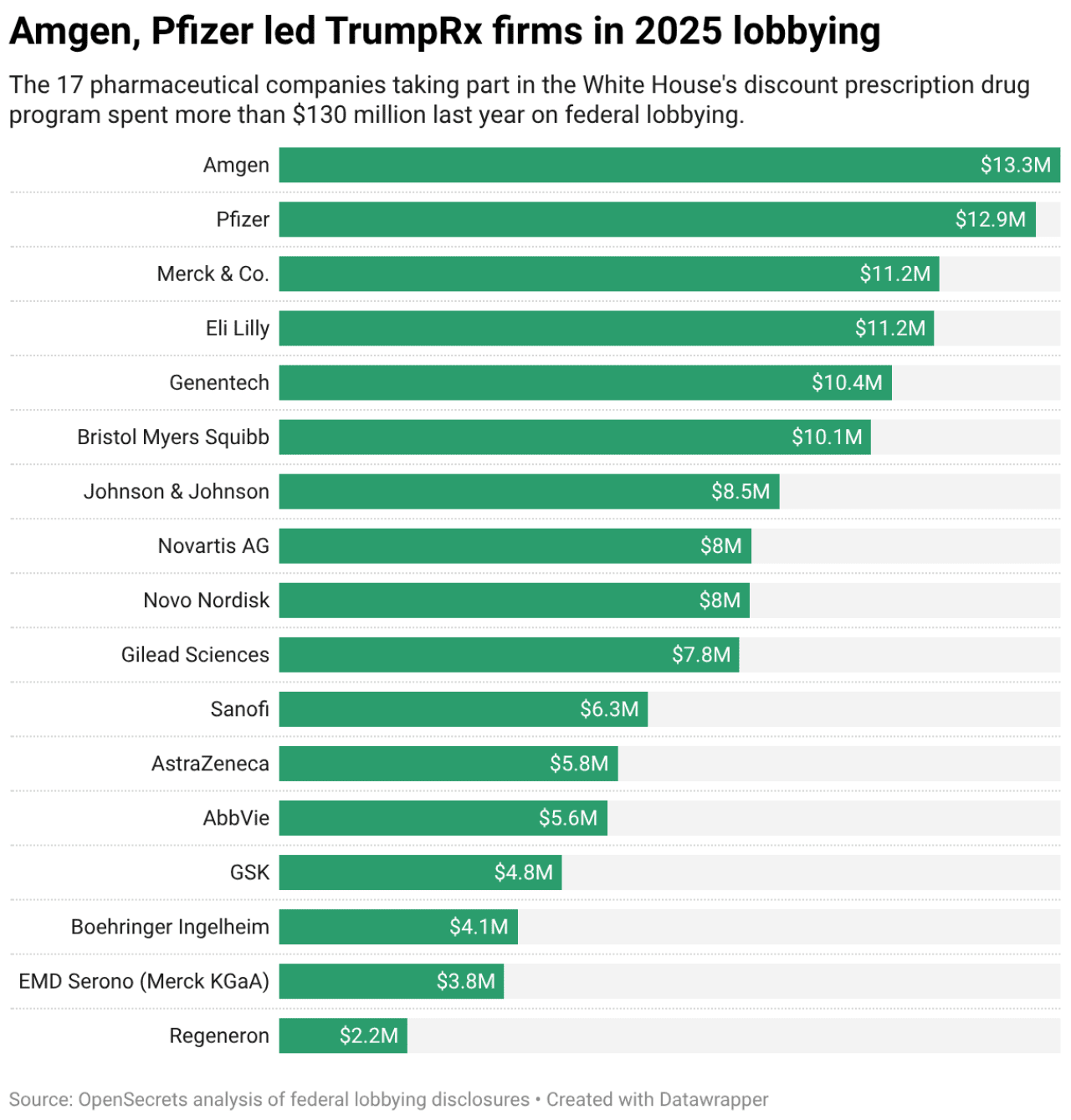
The 17 pharmaceutical companies anchoring TrumpRx, the White House’s new prescription drug-pricing program, poured more than $130 million into federal lobbying in 2025 — a nearly 23% surge that outpaced the broader industry as the plan was being shaped behind the scenes.
Those companies accounted for more than a quarter of the record $457.3 million spent on lobbying last year across the pharmaceutical and health product industry. And while newly filed 2026 first-quarter reports show no slowdown — industry-wide spending topped $131 million, a 5.7% year-over-year increase — the most consequential lobbying push came in 2025, ahead of TrumpRx’s February launch.
“All I can say is that they’re spending a ton of money,” Olivier Wouters, an associate professor at Brown University who has researched the industry’s lobbying efforts, told OpenSecrets.
Among those participants in President Donald Trump’s flagship “most favored nation” drug-pricing initiative, the 2025 spending spree was nearly universal: 15 increased their year-over-year totals, and eight — including Regeneron, which didn’t join until April 23 — boosted spending by at least 25%, an escalation that coincided with the plan’s final negotiations.
The two companies with the steepest increases market blockbuster medications that saw deep price cuts in 2026.
Bristol Myers Squibb, maker of the anti-clotting drug Eliquis, nearly doubled its lobbying spending — an 84% jump to more than $10 million, one of the sharpest increases by any company in any sector. The surge came as Eliquis, which generated $13.3 billion in worldwide revenue in 2024, became subject to a 56% negotiated discount for Medicare Part D enrollees, dropping to $231 for a 30-day supply.
And AstraZeneca hiked its federal lobbying spending by more than 55% to nearly $5.8 million as the negotiated price of its diabetes and heart- and kidney-disease drug Farxiga — an $8.4 billion product in 2025 — was slashed 68% to $178.50 under the Inflation Reduction Act.
TrumpRx offers brand-name drug discounts indexed to lower international prices. In exchange for offering these most-favored-nation rates to cash-paying customers, the administration granted participating drugmakers multi-year exemptions from new import tariffs.
Citing national security concerns, Trump issued a presidential proclamation April 2 imposing a 100% tariff on imported patented drugs and pharmaceutical ingredients from countries without a qualifying security agreement. The proclamation also created a carve-out for companies that enter most-favored-nation pricing and onshoring agreements — core components of the TrumpRx platform — allowing them to pay a 0% tariff through Jan. 20, 2029, a concession potentially worth billions.
Another function of the program allows manufacturers to sell high-volume medications, including popular GLP-1 weight-loss drugs, directly to patients while bypassing insurance gatekeepers.
Health care has long dominated Washington’s K Street, as the lobbying industry is known. In 2025, 2,632 clients lobbied health-related issues — breaking the 2021 record of 2,624, according to OpenSecrets data. Federal lobbying reports do not indicate whether a company supported or opposed a bill, or how much of its total spending was directed toward an issue.
Omer Unsal, an associate professor at Merrimack College who has studied pharmaceutical lobbying trends, said he’s seeing steady growth across the board: more money being spent, more bills being lobbied, and more “revolving door” lobbyists cycling in from positions in government.
“Overall, the trend is upward, and I think there has to be some benefit in exchange for those lobbying expenditures,” Unsal said.
Twelve of the industry’s top 15 spenders were among those firms, including Genentech, which accounted for $10.4 million of the $11.4 million spent by parent company Roche Holdings. However, these firms were already among the industry’s biggest spenders — 11 ranked in the top 15 in 2024 — and simply increased their totals in 2025.
In all, the 17 firms spent nearly $134 million on federal lobbying in 2025 — up almost 23% from $109 million the year before, outpacing the industry’s 15% increase.
That tally does not include the industry’s leading trade group, the Pharmaceutical Research & Manufacturers of America, which represents many of the same companies. PhRMA spent a record $38.2 million in 2025 — trailing only the U.S. Chamber of Commerce and National Association of Realtors — and lobbied on 73 separate pieces of legislation. Its disclosure reports include dozens of references to most-favored-nation drug pricing.
A May 2025 executive order directed federal agencies to implement most-favored-nation pricing — an effort to force U.S. prices down to levels seen in other developed nations. PhRMA has publicly opposed such mandates, calling them a “bad deal” that imports prices from “socialist countries,” even as TrumpRx has become the administration’s primary voluntary channel for companies to adopt those prices in exchange for trade concessions. After the 2022 passage of the Inflation Reduction Act — which allowed Medicare to negotiate prescription-drug prices — three companies, including AbbVie and AstraZeneca, left the trade group. AstraZeneca rejoined last year.
Several other companies are represented by another trade group, the Biotechnology Innovation Organization. However, companies including Pfizer, AbbVie and GSK left in recent years, and the group’s lobbying spending fell sharply — to $5.6 million in 2025, a decrease of nearly 58% in four years.
“The pharmaceutical industry is dominated by large companies,” Unsal said. “The larger the company, the more resources you have to lobby. But eventually, it goes back to how much government benefit you receive in exchange [for] your lobbying.”
The ‘pill penalty’ fight
The TrumpRx coalition placed significant lobbying attention on a pair of bills targeting how Medicare negotiates prices.
Small-molecule drugs — typically pills or capsules — become eligible for price negotiation four years earlier than biologics, which are derived from living organisms and often treat complex or rare diseases. The Ensuring Pathways to Innovative Cures Act would eliminate that disparity, giving drugmakers an additional four years before negotiations can begin.
Calling the current structure a “pill penalty,” Rep. Greg Murphy (R-N.C.), a urologist, introduced the House version. Sen. Thom Tillis (R-N.C.) sponsored the Senate bill.
How frequently a bill or issue appears is often a signal of a company’s priorities. In this case, 13 of the drugmakers lobbied the House version. Eight also lobbied the Senate version. Together, the bills were referenced in 117 quarterly disclosures filed by TrumpRx-aligned companies. PhRMA mentioned them 75 additional times.
Novartis — whose portfolio includes small-molecule drugs such as Kisqali (breast cancer) and Scemblix (leukemia) — was the most active, citing the bills in 24 total reports.
“That makes sense to me, that [drugmakers are] going after that quite aggressively as well, because they are the ones that have a more material impact on revenues, right?” Wouters said. “I’m not a lobbyist, but you have to pick your battles, and so you’re going to go after the bills that really hit you where it hurts.”
The GLP-1 lobbying boom
Two of those drugmakers also focused heavily on legislation affecting their most popular, and lucrative, products: GLP-1 drugs often used to help with weight loss.
Eli Lilly & Co. — maker of Mounjaro, Zepbound and the newly approved Foundayo pill — increased its lobbying spending nearly 33% in 2025 to $11.2 million. Novo Nordisk, which produces Wegovy and Ozempic, hiked its spending by more than 37% to over $7.23 million, a total that does not include spending by subsidiary Novozymes North America.
Both companies lobbied the Treat and Reduce Obesity Act, which would allow Medicare Part D to cover weight-loss drugs, specifically those GLP-1s. Sen. Bill Cassidy (R-La.), a gastroenterologist who chairs the Health, Education, Labor and Pensions Committee, sponsored the Senate version; Rep. Mike Kelly (R-Pa.) sponsored the House bill.
Lilly, the most active pharmaceutical company lobbying on the legislation, referenced the Senate version in six reports and the House version in four. Novo Nordisk mentioned each version twice.
Those companies also hired the same lobbying firm: Checkmate Government Relations, which under close Donald Trump Jr. associate Ches McDowell has quickly become a power player on K Street. In the first year of Trump’s second term, Checkmate’s federal lobbying revenue exploded from $70,000 in 2024 to $22.5 million in 2025.
Eli Lilly paid the firm $400,000 for six lobbyists while Novo Nordisk paid $360,000 for five. Four lobbyists worked for both drugmakers, including McDowell; Chris LaCivita Jr., the son of a top Trump 2024 campaign adviser; and Frederick “Fritz” Vaughn, a former House senior counsel and deputy assistant Treasury secretary.
In November 2025, the White House announced a “historic” agreement with both drugmakers that cut the price for several GLP-1s to roughly $350 — and to $150 for oral versions — through TrumpRx. The deal also allows Medicare and Medicaid to cover those drugs for the first time — a policy shift the industry has long tried to achieve.
Overlapping lobbying networks
Checkmate is just one of several lobbying firms hired by multiple TrumpRx participants. Some represent a staggering number of them.
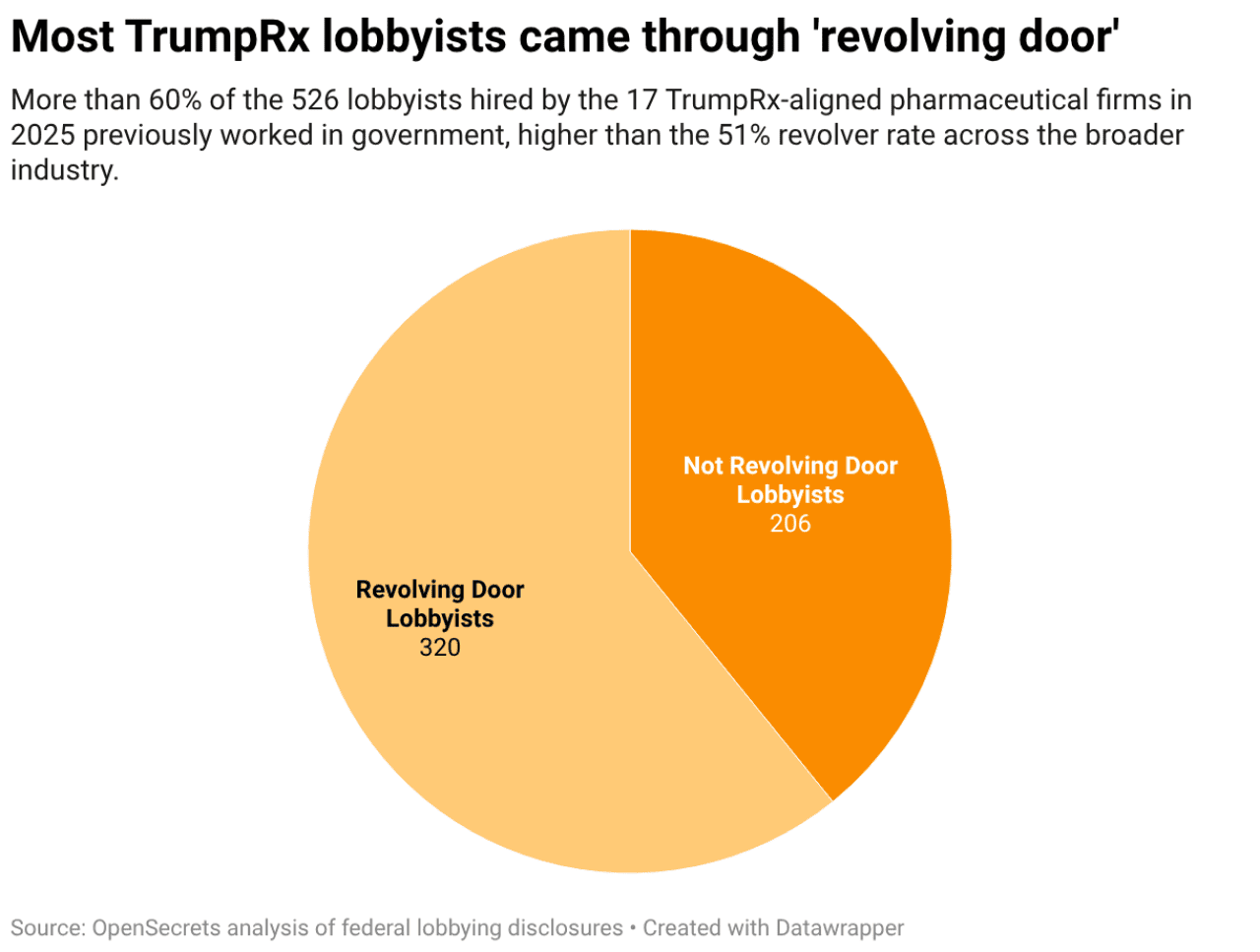
Of the more than 500 lobbyists representing the 17 companies, more than 60% were revolving-door lobbyists. That outpaces the 51% revolver rate across the broader pharmaceutical and health-products industry.
Among the participants, that influence is highly concentrated: 166 represented multiple drugmakers, including 17 who represented 10 or more.
Twelve of the 17 companies hired at least one of four firms with the closest ties to the Trump administration: Checkmate, Miller Strategies, BGR Group or Ballard Partners.
Ballard Partners was founded by Brian Ballard, a former Trump Victory PAC chair, and counts White House Chief of Staff Susie Wiles as a former lobbyist along with former Attorney General Pam Bondi. BGR Group is led by former Trump campaign adviser David Urban and previously employed Transportation Secretary Sean Duffy. Miller Strategies is headed by Jeff Miller, the finance chair for the Trump-J.D. Vance inauguration.
Another major lobbying hub for the firms is the Todd Strategy Group. Paul Edattel, former chief health counsel for the House Energy and Commerce Committee, represented 15 clients — the most of any single lobbyist — across 13 of the companies. Firm founder Dan Todd and Eric Bergren, former chief of staff for Rep. Brett Guthrie (R-Ky.), each represented 13 clients across 12 companies.
Several former lawmakers appear across the firms’ rosters. Former Rep. Kurt Schrader (D-Ore.) lobbied for five drugmakers — Eli Lilly, Novo Nordisk, Pfizer, Sanofi and Bristol Myers Squibb. Former Rep. Ed Whitfield (R-Ky.) worked for Gilead, Johnson & Johnson and Genentech. Additionally, former Sen. Richard Burr (R-N.C.) lobbied for Novartis.
“Presumably, the folks that are going to be really useful lobbyists come at a higher price,” Wouters said. “I worry that the interests represented by those with much deeper pockets, if they have a bigger say in these legislative debates, I worry about the outcomes and if all interests are represented. Same thing with the revolving door. … I worry that it’s just not a level playing field.”
This story was produced by OpenSecrets and reviewed and distributed by Stacker.


