Jesus: His Message and His Mission (Part 1 of 2)
Ministries > Truth For Life with Alistair Begg
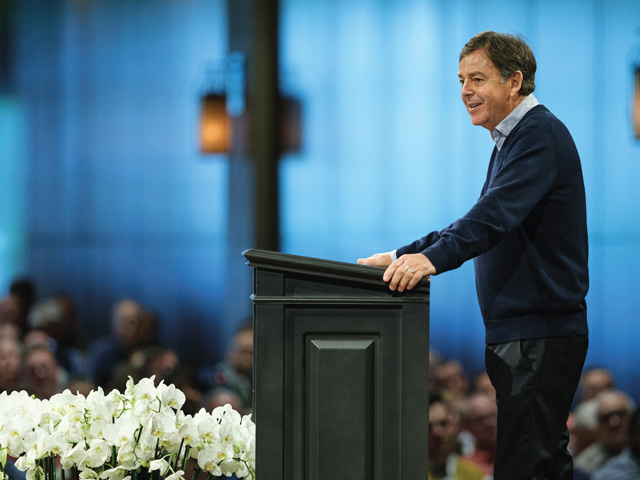
 Are you a “Jesus, take the wheel” person, able to give God full control? Or do you have more of an “I’ve got this” attitude, calling on Jesus only in times of desperation? On Truth For Life, Alistair Begg explains how Christ’s reign should affect our lives.
-----------------------------------------
• Click here and look for "FROM THE SERMON" to stream or read the full message.
• This program is part of the series A Study in Mark, Volume 1’
• Learn more about our current resource, request your copy with a donation of any amount.
• If you struggle to pray because your mind drifts, you don't know what to say, or you even question if God is listening and able to answer, transform your prayer life by learning to pray like the apostle Paul! ‘Download the free audiobook Pray Big by Alistair Begg.’
Helpful Resources
- Learn about God's salvation plan
- Read our most recent articles
- Subscribe to our daily devotional
Follow Us
YouTube | Instagram | Facebook | X
This listener-funded program features the clear, relevant Bible teaching of Alistair Begg. Today’s program and nearly 3,000 messages can be streamed and shared for free at tfl.org thanks to the generous giving from monthly donors called Truthpartners. Learn more about this Gospel-sharing team or become one today. Thanks for listening to Truth For Life!
Guest (Male): Are you a "Jesus, take the wheel" kind of person, able to relinquish control of your life to God, or do you lean more in the direction of "I've got this," preferring to captain your own life with Jesus as the co-pilot, there for emergencies only? Today on Truth For Life, Alistair Begg explains how Christ's reign should affect our lives.
Alistair Begg: Mark chapter 1 and verse 14: After John was put in prison, Jesus went into Galilee, proclaiming the good news of God. "The time has come," he said, "the kingdom of God is near. Repent and believe the good news." As Jesus walked beside the Sea of Galilee, he saw Simon and his brother Andrew casting a net into the lake, for they were fishermen. "Come, follow me," Jesus said, "and I will make you fishers of men." At once they left their nets and followed him. When he had gone a little further, he saw James son of Zebedee and his brother John in a boat, preparing their nets. Without delay he called them, and they left their father Zebedee in the boat with the hired men and followed him. Amen. The most successful manager of an English soccer team ever is a Scot by the name of Sir Alex Ferguson. He's the manager of Manchester United, which will be of interest to about one percent of those listening to me. But he has actually written himself into the record books as the most successful manager of all time. Therefore, it is no surprise when, in reading his autobiography, you come on these two sentences. He writes, "I have devoted my life to football. Everything has been thrown overboard for it." I have devoted my life to football. Everything has been thrown overboard for it. That is absolutely unequivocal. It's clear. It's his focus, and everything else is subservient to it. Here in this little section that we've read, we are introduced to four men who are able to say in similar terms, "We have devoted our lives to Jesus. Everything has been thrown overboard for Him." In the calling of the first disciples, as you have it if you're using the New International Version, we are confronted by, challenged by, the way in which these men respond to the lordship of Jesus. As we look at this this morning, we want to recall where we've been. We want to remind ourselves that when we saw Jesus last time in the water, he was there identified by both the Father and the Spirit as the long-awaited Messiah. We then considered him in the wilderness as he was confronted by the powers of darkness, the conflict that rages between the serpent and the seed of woman, and he emerges from that absolutely unscathed. Now Mark tells us that it is after John has been put in prison in the wake of John's imprisonment that Jesus comes into Galilee, and he comes speaking with clarity and with authority. This little section is fairly familiar to many. It will be new territory for some, and I think the best way we can handle it is just to consider two aspects. First of all, the message that Jesus proclaims and then Jesus' mission. The message is recorded for us in a somewhat summary form there in verses 14 and 15. Along the shoreline of Galilee among the people whose lives were lived within the framework of the fishing industry, Jesus came proclaiming the good news that comes from God. The message that he brought is the message of Mark's Gospel; indeed, it is the gospel message. Mark 1:1, "the beginning of the gospel about Jesus Christ, the Son of God." Jesus now comes to preach in Galilee, and his message is the same. He's proclaiming the good news of God. The clarity of this, I think, is helpful because people want to make Jesus into all kinds of things. They want him to be the proponent of this and of that, and it's good for us just to look at our Bibles and see how Jesus is introduced to us. In other words, we should allow Jesus to identify himself, to speak on his own terms, thereby saving us from flights of fancy whereby we create a Jesus of our own design, a sort of designer Christianity that fits whatever our predilection may be. Instead, when we come to the Bible, we discover that Jesus introduces us to a standard of righteousness to which he calls us to conform. His teaching is no new teaching, although it had a freshness to it, which is probably why the people in verse 27 were saying, "What is this? A new teaching, and with authority!" It's presumably just the contrast between the boring old sermons of the Pharisees going on about the same thing over and over again, the length of the tassels on the prayer shawls, the washing of cups, the utensils, and all these different things. The people were just, frankly, falling asleep and bowing down under the weight of it all. Now comes Jesus, this carpenter from Nazareth, steps up on the stage, and he speaks with such freshness that people listen to him. It is interesting just in passing, is it not, that having arrived on the stage of human history, his methodology is preaching? He speaks God's word. He comes as a preacher. Yes, he heals. Yes, people's lives are changed. But he actually is the one who is proclaiming, preaching, declaring the good news of God. What is involved in this good news of God? In verse 15, you really have a summary. It's almost like a title to the first eight chapters or so of this Gospel. If you go through the eight chapters of the Gospel and then you say to yourself, "Now, what is it that Jesus has been saying in each of these encounters, broadly speaking?" You will find yourself coming back to verse 15 of chapter one and saying, "Here we have it. This makes perfect sense." "The time has come," he said. "The kingdom of God is near. Repent and believe the good news." Let's just take a moment or two and look at each of these phrases. First of all, "The time has come," or "the time is fulfilled." It is important for us to recognize that Jesus does not simply stand out in the context of Galilee without the background of all of God's purposes, indeed from eternity. One of the people who's helped me most recently to see this is an Australian theologian by the name of Graeme Goldsworthy, and I have been touting his book everywhere I go. Every so often, someone buys one, but most of the time they just ignore me. I want to give you just a little touch of this in light of the phrase, "The time is now fulfilled," or "the time has now come." This is what Goldsworthy writes. He says, "God's acts in history are never an afterthought in response to the contingent." In other words, something's happened and then God does something in response. The notion that what God did in Jesus is the fulfillment of time and the fulfillment of prophecy implies the sovereignty of God over all history. The Gospel shows that the movement from creation to new creation is inevitable. The incarnation as a historical event is the focus of God's rule in world history. Furthermore, all world history is defined by salvation history, so that all the peoples of the world are implicated one way or another in the saving events. He goes on to say that the history of the Bible begins with a word of God calling all things into being, setting humanity on its historical course, and eventually will end when God brings the history of the present order to its finality. Then in just one sentence, he says, "History cannot be understood without God's word to interpret it." History cannot be understood without God's word to interpret it. Where we are in the world and what is happening in the world is not divorced from the statement made by Jesus here as he enters into Galilee. "The time has come. The time is fulfilled." Many of his readers would have been familiar with the words of the prophet. They told of how the Sovereign Lord would come in power. John the Baptist had picked up the words of the Old Testament prophet in the opening verses we have here if your Bible is open in front of you. All that was anticipated in the prophecy of John now finds its fulfillment in the person of Jesus. The people who have been walking in darkness now have seen a great light. Those who were living in the land of the shadow have encountered the light of the Lord Jesus. Those who have experienced the silence of 400 years since Malachi, since the end of the Old Testament prophets, now are listening as the news of the Word of God dawns upon them from the lips of Jesus. In his baptism, Jesus has been identified and installed as the King. Now, of course, there is no surprise that he says, secondly, "The kingdom of God is near. The kingdom of God is near." In other words, God's rule over people's hearts and lives is being established. When we think of the proximity of the kingdom of God, we ought to think of it in terms of Jesus. The kingdom of God is close to people in the person of Jesus. This, of course, will be worked out throughout the rest of Mark's Gospel. For now, you should note just this: that essentially the kingdom of God is God's rule. In fact, when we studied the overview of the Bible, we used the language of Goldsworthy that was picked up by Vaughan Roberts, where he spoke about God's people in God's place under God's rule and authority. That was expressive of his kingdom, that his rule is in the hearts of people. One day, his rule will be so clearly established that there will be, in terms of Revelation 21, a new heaven and a new earth in which dwells righteousness. There will be no tears. There will be no more sorrow or sighing. There will be no more cancer. There will be no more need for trips to the emergency room. There will be no seminars on divorce recovery. There will be none of that necessary when the kingdom of God is established in its fullness. In an encounter with Jesus, he comes to rule and reign in the lives and hearts of individuals, anticipating the day when his rule will be established in its finality. I don't think that the picture is so much the idea of a partial reign moving to a completed reign as it is being a reign or a rule that is veiled that will eventually just become apparent to everyone. Right now, Jesus just appears to be a Galilean carpenter who lived 2,000 years ago. The Bible actually says that he is the King of the universe, that he is the Sovereign Lord of creation, that he is ascended to the right hand of the Father on high, and from there he will come to judge the living and the dead. But again, our friends and neighbors just go on their merry way. There's no concept of that at all. If they're going to encounter his kingly rule, it's going to have to be in your life or in mine. They're going to have to say, "Well, why is it that you are so interested in Jesus? Why is it that you pay so much attention to his book? Why is it that you spend time with others who love Jesus?" The answer is going to be because he is the King and he has come to rule and to reign. I got out of the driver's seat some time ago, we might say, and Jesus has been driving the car of my life ever since. This is opposed to a notion of Christianity whereby Jesus of Nazareth is added into a little seat somewhere in the rear of the automobile just so that we can have him as an insurance policy in case anything goes wrong. But we don't want him fiddling around with the steering wheel. We don't want him taking our lives and letting it be consecrated, Lord, to thee. We don't want him interfering with our moments and our days. We don't want them flowing in ceaseless praise. No, we'd like to keep all of that for ourselves, but we'll just have Jesus over here in case anything goes horribly wrong or just in case we will need him if push comes to shove. Nobody could ever misunderstand that as being loyalty to a king. The kingly rule of Christ in the hearts and lives of his followers will be seen in a far more dramatic way. And that is why you will notice that he says, "Repent and believe the good news." The time is fulfilled, that which the prophet said has now arrived. The kingdom of God is near in me, and so I want you to repent and to believe the good news. This is a phraseology that you find frequently throughout the New Testament. The Apostles pick it up quickly. You remember on the day of Pentecost when at the end of his sermon, the people cry out to Peter, "What should we do?" He says, "Repent and believe the gospel. Repent and be baptized." Jesus says the same thing. Peter had learned it well. To repent means to have a change of heart, a change of mind, and a change of direction. To repent does not mean to feel sorry. There may be sorrow in repentance, but sorrow doesn't equal repentance. To repent does not mean to feel sorry because I got found out, and if I hadn't been found out, I wouldn't be sorry. To repent means to so be encountered by the kingly rule of Jesus that the control center of our lives is turned over entirely to him. All of our hopes, all of our dreams, our mind, our emotions, our business life, our family life, our sex life, our financial life—all of it under his kingly rule. By nature, it is not. Therefore, if that is to become the case, then this repentance is something that needs to happen in our lives. The question, of course, that is inevitable when we read verses like this, when we personalize them in the silence of our own minds as you're listening to me speak, we find ourselves inevitably saying, "Has there come a point in my life ever where there has been this radical change of heart and mind and direction?" It'll never happen on its own. It will never happen absent faith, at least not life-changing repentance. Don't misunderstand repentance as being simply a desire to get religion, to turn over a new leaf, to fix up my life. There are plenty of opportunities to do all of that, and there are plenty of books that are written that will tell you how. You can change your statistics physically. I noticed yesterday in the Wall Street, there is an opportunity now to go to the mental gym. Did you see all that stuff yesterday on the gym for your mind? You can go there and play little games so that you can help yourself not lose your car keys in the future. It makes perfect sense to me. But there's another opportunity to change something, and I think people often come to churches, and what they hear is something like this: "Now, it's time for you to go out and get yourself changed, so I'd like you to change yourself and do it as quickly as you possibly can, please." And so you think, "Well, that's what religion is, and I just have to fix something up and change something around, and I might as well do it at church as do it anywhere else. So let's get going." That's not what Jesus is saying. Because the repentance that involves a change of heart and mind and direction is posited, is built upon, is grounded in, is related to faith in the Lord Jesus Christ. Why would I change anything about myself in relationship to Jesus of Nazareth, a Galilean carpenter who lived 2,000 years ago? Why should I? He's not around. Well, no, you see, but when I understand who Jesus is, and when I understand what Jesus accomplished when he died on the cross, that he died a death that I deserved to die because I was the one in the wrong and he wasn't, that he showed the kindness of God towards those who'd rebelled against him—when I am encountered by that, when I understand that, when I realize that he gave his all for me, then it only makes perfect sense that invaded by that transforming power, in faith, I would turn away from everything that represents my own selfish agenda. I would no longer find myself saying, "Well, I can do what I want. I can live with whoever I want. I can choose whatever I want." Of course you can, but not if you're a disciple of Jesus. Because the disciple of Jesus has no legitimacy in believing anything other than what Jesus taught. And the disciple of Jesus has no basis upon which to behave in any other way than what Jesus demands. And that's why Jesus says, "Here I am. The time is fulfilled. The kingdom of God is near. The king is present. Now I want you to repent and to believe the good news." When we do, the promise of God is that we enter into life that is truly life. We make sense of life. We make sense of death. We make sense of human frailty. We just make sense of things. That, of course, is what people are trying to do one way or another, just trying to make sense of life. Who am I? Where do I come from? Where am I going? And does it matter? What should I do as all these bits and pieces start to fall off of me as I begin to disintegrate with age? What shall I do? How can I fix this? If you were reading the Wall Street this week, you would have noticed that very interesting article on these architects, Mr. Arakawa and Madeline Gins, who are involved with an organization or a belief system called transhumanism. I must confess I'd never heard of it till this week. I've been fascinated by it ever since. This was an article about this couple who design homes to prolong life because apparently they're going to be living forever. And the reason they're going to be living forever is that transhumanism is posited on the idea that people degenerate and die, in part, because they live in spaces that are too comfortable. So that's why people die. If we can just get them in uncomfortable spaces, these architects have decided, then they'll be able to live forever. There's a possibility of immortality. It's a fascinating idea, isn't it? And so according to this article, they build buildings with no doors inside. They place rooms far apart. They put windows near the ceiling or near the floor, and between rooms are sloping, bumpy, moonscape-like floors designed to throw occupants off balance. And these features, they argue, stimulate the body and the mind and thus they prolong life. It's great, isn't it? So you're just trying to find a way to open a window in the middle of the night, but it's so high up. "Where's that glass, honey? Don't worry, you'll get it. Go ahead." Bam! It comes down. "Oh, hang on, I'm coming, honey. I'll get you." She falls over and breaks her hip. He's lying down all crushed. While there's an "Eeee-ooo-eee-ooo," and now they're going, "Hmm," and they're looking at each other going, "Hey, but this is good. We're going to live forever. This is fantastic!" But why does it even—how can it even make it into the newspaper? Because the fact of the matter is death is the great fear. Death is the fear of all fears. That is what everyone is afraid of. And the question is, is there anybody who has conquered death and made a way for me to conquer it? Jesus stands on the stage of human history and he says, "Listen, the time is fulfilled. The kingdom of God is near. I want you to repent and believe the good news." John summarizes it in memorable words: "For God so loved the world that he gave his only begotten Son, that whosoever believes in him should not perish but have," exactly what these architects are looking for, "everlasting life."
Guest (Male): You're listening to Truth For Life with Alistair Begg. We'll hear the conclusion tomorrow. At Truth For Life, we want everyone to believe in Jesus and to enjoy everlasting life. That's why we make it our practice to offer as many free or at-cost biblical resources as possible. We want to provide clear, relevant Bible teaching to anyone who wants to learn more. So we've got a special offer for you. It's Alistair's audiobook titled *Pray Big: Learn to Pray Like an Apostle*, and you can download it for free today, along with a companion study guide. Prayer is difficult for most of us. Our minds drift and we get interrupted. We get stuck in repetitious requests, and that's where Alistair's book can help. He walks you through the Apostle Paul's heartfelt prayers for the believers in Ephesus and examines the spiritual truths that underpin the apostle's certainty that God was working in their lives. Paul didn't pray for comfort or material provision; he prayed for believers to be strengthened by God, to have an unshakable hope, to have confidence in God's continual presence. This book shows you how you can pray like this for the ones you love. Would you like to learn how to pray, why to pray, what to say when you pray? Download the *Pray Big* audiobook and the study guide for free today at truthforlife.org/praybig. Share that link with friends so you can learn to pray big together. Thanks for joining us today. You ever feel like you don't have enough talent or the right personality for God to use you? You might be surprised. Join us tomorrow to find out why. The Bible teaching of Alistair Begg is furnished by Truth For Life, where the learning is for living.
Related Episodes
Jesus: His Message and His Mission (Part 2 of 2)
Wednesday, September 16
Jesus: Baptized, Tempted
Monday, September 14
“Look and Be Amazed!”
Saturday, September 12
About Truth For Life
Truth For Life distributes the unique, expositional Bible teaching of Alistair Begg. Studying God’s Word each day, verse by verse, is the hallmark of this ministry. In a desire to share the good news of the Gospel without cost as a barrier, the entire teaching archive is available for free download and resources are available at cost with no markup.
About Alistair Begg
Alistair Begg has been in pastoral ministry since 1975. Following graduation from The London School of Theology, he served eight years in Scotland at both Charlotte Chapel in Edinburgh and Hamilton Baptist Church. In 1983, he became the senior pastor at Parkside Church near Cleveland, Ohio. He has written several books and is heard daily and weekly on the radio program, Truth For Life. The teaching on Truth For Life stems from the week by week Bible teaching at Parkside Church. He and his wife, Susan, were married in 1975 and they have three grown children.Contact Truth For Life with Alistair Begg
Website
http://www.truthforlife.org/?utm_source=oneplace&utm_medium=sitelinks&utm_campaign=home
Mailing Address
Truth For Life
P.O. Box 398000
Cleveland OH 44139
Telephone (Customer Service)
888-588-7884 Domestic
400-543-6800 International
440-543-0522 ( Fax)


